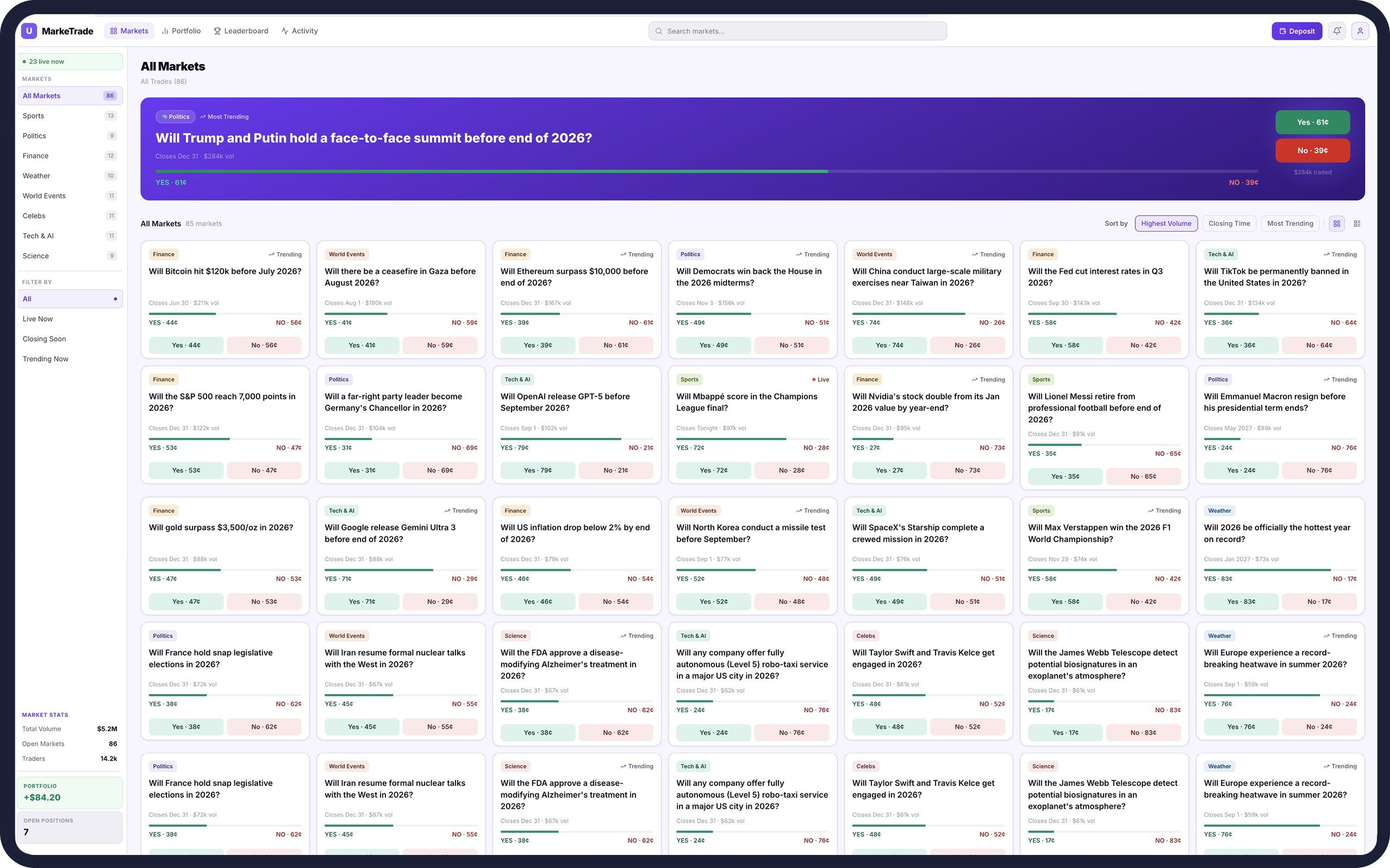
MarkeTrade
AI-Powered Product Design & Development Experiment
MarkeTrade is a conceptual fintech prediction platform created as an exploration of modern AI-assisted product design and development workflows.
The project was designed in Claude Code and refined in Figma. Later on, developed through an AI-native process using Claude Code and Figma MCP, demonstrating how designers can rapidly transform ideas into functional digital products.
Project Overview
The goal was to evaluate how emerging AI tools can accelerate the product creation process while maintaining a high standard of user experience and visual design.Starting from a simple product concept, the project evolved into a fully designed and functional trading platform prototype, showcasing the collaboration between human design direction and AI-assisted implementation.
The project followed an AI-native workflow that combined design thinking with rapid implementation.
Design in Claude Code and Figma
The product definition, user experience, visual language, and components were created in Claude Code, then moved to Figma for refinement and polishing, with a focus on the usability expected from a modern fintech product.
Claude Code and Figma MCP
AI-Assisted Development Using Claude Code and Figma MCP: Design assets and specifications were translated into production-ready interfaces through an iterative collaboration process using Claude’s skills and commands. Rather than manually building every component from scratch, the workflow leveraged AI to accelerate development while maintaining design consistency.
Each iteration began with identifying friction points, usability gaps, or opportunities to improve clarity. Using Figma MCP, design updates could be applied directly to the source files while Claude Code simultaneously generated and adjusted production-ready implementations. This eliminated the typical disconnect between design and development, allowing concepts to be validated immediately instead of waiting for lengthy implementation cycles.
The workflow encouraged experimentation at every stage. Layouts, interaction patterns, visual hierarchy, microcopy, data visualizations, and user flows were continuously tested, challenged, and improved based on real-world usage and evolving product requirements. Rather than aiming for a perfect solution upfront, the product evolved incrementally through rapid prototyping, review, and refinement.
This highly iterative process significantly accelerated decision-making, reduced implementation overhead, and enabled the platform to mature from an initial concept into a polished prediction experience with focus on usability, performance, and user engagement.
View Live Project Online >